.png)


Priceless Perspectives #46: Leading Across Generations — Different Lenses, Shared Purpose

Leadership growth isn’t one-size-fits-all. Some leaders learn through practical workplace insight. Others through story. Some through Scripture. Others through the executive lens. That’s why each weekly theme is explored through four different perspectives… so you can grow in the way that reaches your heart, your mind, and your leadership practice.
This Week’s Theme: Leading Across Generations
Today’s workplace brings together people shaped by different technologies, economic conditions, cultural moments, and experiences with work. Those differences can influence what people value, how they communicate, what motivates them, and what they expect from leadership. But generational understanding should never become generational stereotyping. A generation may help explain part of someone’s perspective, but great leaders stay curious, seek to understand the individual, and recognize that every generation has something valuable to contribute... and something valuable to learn.
To explore this week’s theme, choose the lens that connects with you most or experience all four for a full, 360-degree perspective:
◆ Leadership Lens: Leading Across Generations Without the Labels
◆ Adventures of Noah Hart: Three Reasons to Care
◆ The Shepherd’s Voice: One Body, Many Generations
◆ The Boardroom Brief: The Multigenerational Advantage
Because every leader eventually learns:
A generation may shape someone’s perspective, but it should never define their value.
And always remember… people are priceless!

◆ Leadership Lens
Leading Across Generations Without the Labels
Generational differences can help leaders understand why people may approach work differently, but they become dangerous when understanding turns into assumption. The goal is not to memorize what supposedly defines each generation. It is to become more curious about the experiences, motivations, and perspectives shaping the person in front of us.
Different People May Want Different Things from Work
One person may be energized by purpose and social impact, another by doing meaningful work while protecting time for family, and someone later in their career may care deeply about mentoring others and leaving a legacy. These motivations are not exclusive to any generation, but life stage and experience can influence what matters most. Strong leaders learn what gives work meaning to each person and connect that motivation to a shared purpose.
People do not have to value work in exactly the same way to do valuable work together.
Technology Has Shaped Different Ways of Working
Some employees learned to work before email, smartphones, video meetings, and instant messaging became everyday tools; others have never known a world without them. Those different starting points can influence how people communicate, find information, learn, solve problems, and even define responsiveness. Leaders do not need everyone to prefer the same tools or habits, but teams do need shared expectations that make communication clear and collaboration easier.
Good communication is not about making everyone communicate like us. It is about making sure everyone can understand one another.
Every Generation Has Something to Teach
Experience can bring wisdom, pattern recognition, institutional knowledge, and lessons learned through years of decisions and relationships. Fresh perspective can challenge assumptions, introduce emerging tools, and reveal possibilities others may no longer notice. Healthy multigenerational teams allow learning to travel in both directions rather than assuming wisdom belongs to the oldest or innovation belongs to the youngest.
Wisdom grows when generations are willing to learn from one another.
Practicing Generational Understanding This Week
This week, consider:
Asking someone from another generation what they value most about work
Examining one assumption you may hold about another generation
Clarifying team expectations around communication and technology
Asking someone younger or older than you to teach you something
Sharing your own experience without assuming your way is the only way
The Leadership Ripple
When leaders replace generational assumptions with curiosity, differences become easier to understand and strengths become easier to see. People learn from experiences they have not lived, communicate with greater intention, and discover that different perspectives do not have to divide a workplace.
We do not need every generation to see work the same way. We need every generation to feel valued enough to contribute what it knows.
Check out our previous issues on Rehumanizing Leadership, Listening, Psychological Safety, Empathy, Gratitude, Stewardship, Perseverance, Accountability, Presence, Courage, Discernment, Humility, Integrity, Compassion, Service, Empowerment, Vision, Wisdom, Trust, Consistency, Hope, Belonging, Grace, Clarity, Self-Awareness, Curiosity, Encouragement, Respect, Transparency, Patience, Love, Joy, Authenticity, Adaptability, Resilience, Generosity, Forgiveness, Ownership, Influence, Courageous Conversations, Learning, Excellence, Character, Kindness, Purpose

◆ Adventures of Noah Hart
Three Reasons to Care
The South Dakota prairie stretched beneath a wide September sky as Noah Hart and Luman approached a community center buzzing with activity.
Volunteers carried tables, stocked shelves, and tested computers beneath a banner:
COMMUNITY RESOURCE CENTER — OPENING TOMORROW
A young man hurried past carrying a box of tablets.
“I’m Noah,” Noah said. “I'm traveling across the country learning about leadership.”

“Antonio,” the man replied. “Then you picked a good day. This place will help families with tutoring, job searches, food assistance, and community programs. It’s bigger than a building. It’s about what we can do for people.”
Across the room, another man checked items from a clipboard.
“Antonio, we still need the computer stations finished before five.”
“That’s Eric,” Antonio whispered. “He loves a checklist.”
“I heard that,” Eric replied, smiling. “We open tomorrow. My goal is to finish what we promised, do it well, and get everyone home at a reasonable hour. My son has a baseball game tonight.”
Nearby, an older woman showed two volunteers how to organize the lending library.
“And that’s Virginia,” Eric said.
“I’m retiring soon,” Virginia told Noah. “These days, I’m less interested in being the person who knows everything and more interested in making sure someone else knows before I leave.”
As the afternoon continued, Noah noticed how differently they approached the same work.
Antonio kept reminding everyone who the center would serve.
Eric kept the project moving and protected people’s time.
Virginia slowed down just enough to teach others what they would need after she was gone.
At one point, Antonio suggested adding another display explaining the center’s community impact.
“Tomorrow,” Eric said, checking the clock.
A few minutes later, Eric started assembling the final shelf himself.
Virginia stopped him.
“It’ll be faster if I do it,” Eric said.
“And slower next month when no one else knows how,” Virginia replied.
Eric smiled. “Fair point.”
By late afternoon, the center was ready, and everyone was leaving in time for Eric’s son’s game.
Noah looked at the three of them.
“You all care about this place,” he said, “but for different reasons.”
Antonio nodded. “I care about what it can mean to the community.”

Eric closed his clipboard. “I care about doing good work without forgetting the people waiting for us outside of work.”
Virginia smiled. “And I care about leaving something useful behind.”
“So which reason is right?” Noah asked.
Virginia laughed softly.
“Why does there have to be only one?”
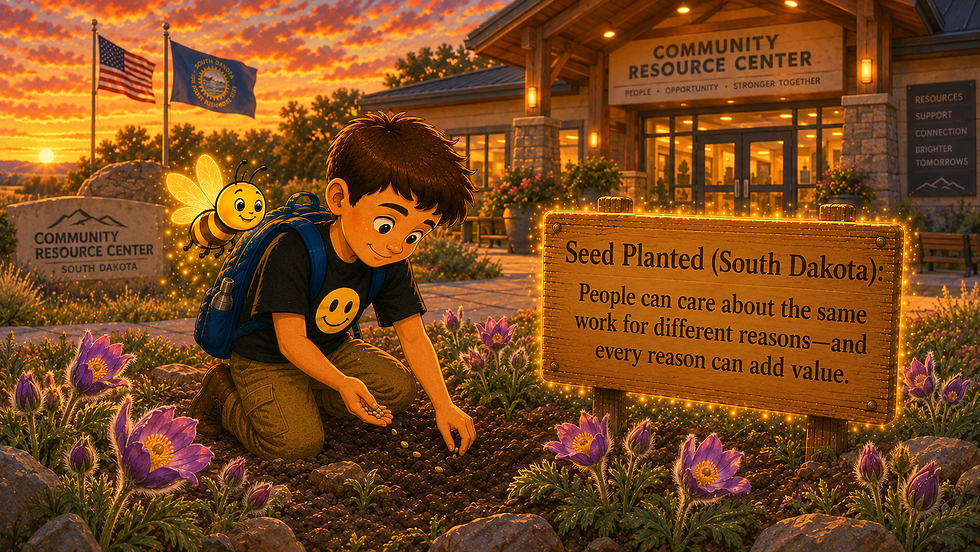
Before Noah left, Virginia handed him Pasque flower seeds, South Dakota’s state flower. Noah planted them near the entrance, and a wooden sign shimmered into view:
Seed Planted (South Dakota): People can care about the same work for different reasons...and every reason can add value.
As Noah and Luman continued across the prairie, Noah thought about Antonio, Eric, and Virginia.
“I thought understanding generations meant figuring out what motivates each one,” he said.
Luman’s glow brightened.
“Generations can give you clues,” he replied. “But people give you answers.”
Noah carried the lesson forward:
Different experiences may shape how people see work, but leadership begins when we become curious enough to understand the person beyond the generation.
Check out our previous issues on Rehumanizing Leadership, Listening, Psychological Safety, Empathy, Gratitude, Stewardship, Perseverance, Accountability, Presence, Courage, Discernment, Humility, Integrity, Compassion, Service, Empowerment, Vision, Wisdom, Trust, Consistency, Hope, Belonging, Grace, Clarity, Self-Awareness, Curiosity, Encouragement, Respect, Transparency, Patience, Love, Joy, Authenticity, Adaptability, Resilience, Generosity, Forgiveness, Ownership, Influence, Courageous Conversations, Learning, Excellence, Character, Kindness, Purpose

◆ The Shepherd’s Voice
One Generation to Another
Theme Verse: “One generation commends your works to another; they tell of your mighty acts.” — Psalm 145:4 (NIV)
Generations in Scripture
Scripture repeatedly shows faith, wisdom, and responsibility moving from one generation to another. Moses prepared Joshua. Naomi guided Ruth. Paul invested in Timothy. Psalm 145 reminds us that each generation has something worth receiving and something worth passing on. God does not ask generations to compete for importance; He calls them to remember His faithfulness, share what they have learned, and help those who follow walk with greater wisdom.
God’s work continues when one generation is humble enough to teach and another is humble enough to listen.
Generational Understanding in a Christian Workplace
Christian leaders should be careful not to reduce people to assumptions based on age. Instead, we can approach generational differences with humility and curiosity by:
Listening before assuming what motivates someone
Honoring the wisdom that comes through experience
Remaining open to new ideas, tools, and perspectives
Creating opportunities for mentoring to flow in both directions
Helping people connect their unique season of life to a shared purpose
The body of Christ has always depended on different gifts, experiences, and stages of life working together. The workplace can reflect that same spirit when leaders value contribution over category.
We honor people across generations when we stop asking which one matters most and start asking what God may have placed in each one for the good of others.
A Leader’s Prayer for Generational Understanding
Dear Lord,
Thank You for the people You place around me whose experiences are different from my own.
Give me humility to learn from those who have walked farther, openness to listen to those who see things differently, and generosity to share what You have taught me without assuming my way is the only way.
Protect me from stereotypes, impatience, and pride.
Help me recognize the gifts You have placed in every generation and create opportunities for people to learn from one another, serve together, and contribute fully.
May my leadership help wisdom travel forward and understanding travel both ways.
Amen.
One Faith-Forward Mini-Challenge
Choose someone from a different generation and ask:
“What has your experience taught you that you wish more people understood?”
Listen without correcting, comparing, or preparing your response. Then ask God to show you one lesson worth carrying forward from the conversation.
Check out our previous issues on Rehumanizing Leadership, Listening, Psychological Safety, Empathy, Gratitude, Stewardship, Perseverance, Accountability, Presence, Courage, Discernment, Humility, Integrity, Compassion, Service, Empowerment, Vision, Wisdom, Trust, Consistency, Hope, Belonging, Grace, Clarity, Self-Awareness, Curiosity, Encouragement, Respect, Transparency, Patience, Love, Joy, Authenticity, Adaptability, Resilience, Generosity, Forgiveness, Ownership, Influence, Courageous Conversations, Learning, Excellence, Character, Kindness, Purpose

◆ The Boardroom Brief
The Multigenerational Advantage
A multigenerational workforce can bring different expectations around purpose, communication, technology, flexibility, and career growth. But the executive challenge is not to create a separate leadership strategy for every generation. It is to understand meaningful differences without turning them into stereotypes.
Employees Value Generational Diversity But Do Not Always Feel Valued Across Generations
The American Psychological Association’s 2024 Work in America survey found that 87% of workers believe having employees from a range of age groups is an advantage, and 92% appreciate opportunities to work with people of different ages. Yet nearly one-third said coworkers who are not close to their age do not value their ideas. Among workers ages 18–25, that number rose to 48%.
The lesson for executives is simple: representation alone does not create a multigenerational advantage. People must also believe their experience, ideas, and contributions are respected.
Age diversity creates potential. Mutual respect unlocks it.
Generational Trends Offer Clues, Not Conclusions
Deloitte’s 2025 survey of more than 23,000 Gen Z and millennial workers found that purpose matters greatly to younger employees but “purpose” meant different things to different people. Some connected it to social impact, while others connected it to financial security, work-life balance, personal growth, or the ability to pursue meaningful goals outside of work.
That distinction matters. Executives can easily turn useful trends into limiting assumptions: younger workers want purpose, mid-career employees want balance, older employees want legacy. Those patterns may help leaders ask better questions, but they cannot replace knowing the individual.
Generational data should start a better conversation, not end one.
Technology Creates Different Starting Points, Not Different Levels of Potential
Technology may be one of the clearest areas where generations have experienced work differently. Some employees entered the workforce before email and smartphones; others have never known a world without them.
But age should not become shorthand for capability. A 2025 AARP and LinkedIn analysis found that the technology-learning gap between older and younger professionals narrowed substantially between 2022 and 2025. At the same time, younger workers are rapidly adopting emerging tools such as generative AI.
The opportunity is not to decide which generation is more technologically valuable. It is to create environments where knowledge moves both ways. Younger colleagues may help others navigate emerging technologies, while experienced employees contribute judgment, relationships, institutional knowledge, and lessons learned over time.
The advantage is not having multiple generations. It is getting multiple generations to exchange what they know.
The Boardroom Questions
Where are we making assumptions about people based primarily on age?
Do employees across generations believe their ideas are taken seriously?
Are managers learning what motivates individuals rather than relying on generational shorthand?
Where could learning and mentoring deliberately flow in both directions?
Bottom Line
A multigenerational workforce is not a problem to manage. It is a collection of experiences, perspectives, skills, relationships, and knowledge that leaders can either unlock or waste.
Strong executives understand generational trends while continuing to see the individual beyond the category. The goal is not to make generations more alike. It is to create a workplace where people respect what others bring, remain curious about what they do not understand, and learn enough from one another to become stronger together.
Check out our previous issues on Rehumanizing Leadership, Listening, Psychological Safety, Empathy, Gratitude, Stewardship, Perseverance, Accountability, Presence, Courage, Discernment, Humility, Integrity, Compassion, Service, Empowerment, Vision, Wisdom, Trust, Consistency, Hope, Belonging, Grace, Clarity, Self-Awareness, Curiosity, Encouragement, Respect, Transparency, Patience, Love, Joy, Authenticity, Adaptability, Resilience, Generosity, Forgiveness, Ownership, Influence, Courageous Conversations, Learning, Excellence, Character, Kindness, Purpose
Join the Movement That Sees Beyond Generations
Generational differences can influence how people communicate, what they value, and how they experience work. But strong leadership begins when we move beyond assumptions and become curious about the person in front of us.
If this issue encouraged you, consider sharing it with a colleague, mentor, team member, or leader from another generation. And if you want to build a workplace where different perspectives, experiences, and strengths become an advantage rather than a source of division, we would love to walk alongside you.
Learn more at: nationalald.com
Start a conversation: Book a 30-minute exploration call
Email: scott@nationalald.com
Because when leaders replace generational assumptions with curiosity, something powerful happens…
People stop seeing age as a barrier, start seeing one another as resources, and discover how much stronger we become when every generation has something to contribute.
And always remember… people are priceless!


Comments